
Below is an extract from the talk I gave at Llangollen in August on John Copwer Powys's philosophy for living a happy and fulfilled life. Although he developed his philosophy of life between the 1920s and 1950s, much of what he has to say is highly pertinent to the world in which we live.
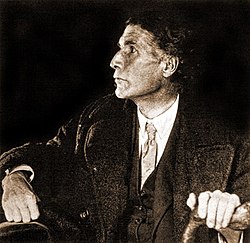
John Cowper Powys (1872-1963)
In these early years of the 21st century, we are facing a
series of economic, social, political and environmental crises that are
impacting on all our lives. I believe
that many of John Cowper Powys’s ideas can assist us in understanding and
overcoming these problems and if adopted, will lead to a happier and more
fulfilled life for the individual and a better world for all.
We live in a 365, 24/7 society in which our lives are
dominated by work and consuming, lived predominately in urban environments, and
where everything is uniform and standardized.
Observing these trends while living in America, JCP comments:
“It is a sickening and
shocking sight, to set eyes upon the great majority of the people in our large
modern cities, who go to and fro along the pavements. What automatic avidity! What callous indifference! What benumbed and distracted
preoccupation!..” and he continues “the human race, in these modern commercial
times, has got itself caught in a relentless machine that turns living, sensitive
people into pallid, galvanised automatons…”
Who, today, cannot relate to this picture of everyday life?
In his philosophical works, JCP identifies the detrimental
physical, mental, psychological and spiritual effects of modern society on our
well-being. He believed that scientific
and technological innovations brought many benefits but they came at a price;
we have been transformed from human beings into ‘cogs in the machine,’ into
workers and consumers, who instead of feeling alive, ‘sleep-walk’ through life,
merely existing. He acknowledges the
need for money but the problem is that it has taken over our lives and despite
having a high standard of living, many people are restless and unhappy.
JCP is not alone in drawing these conclusions. In ‘To Have or To Be’, Erich Fromm noted,
“We are a society of
notoriously unhappy people: lonely, anxious, depressed, destructive, dependent
— people who are glad when we have killed the time we are trying so hard to
save.”
In a world obsessed with money, possessions and celebrity,
JCP reminds us of some essential truths we have forgotten to our cost; money
does not guarantee happiness. In this,
he has been proved correct as social surveys consistently demonstrate that increased
wealth and material possessions do not translate into happiness yet, we
continue to equate the two. The
acquisition of money and possessions, preoccupation with ambition and status
and the world of work are the driving forces behind all our actions and are
seen as good for the economy and for the individual - but in reality, they only
leave us feeling empty and do not translate into the happiness and freedom that
society promises.
In his exploration of the nature of happiness, JCP makes an
important and insightful distinction between happiness and pleasure which can
help us to understand why it evades us.
He also suggests that if material possessions, social activities, status
and success do not make us happy then we must be looking in the wrong places. He says,
“The truth is that we
human beings, have become so dominated by trivial, hollow, sapless
crowd-complexes - that in place of making it the purpose of life to feel a
certain kind of happiness, - we make it the purpose of life to win money,
reputation, respect….”
At a time of major economic and social crises and growing
inequality between rich and poor, he gives us much to reflect upon. He asks some fundamental questions in
relation to society’s values and our personal motivations that are very
relevant today, such as
“Why have we allowed a
minority of us to be so rich, another minority be so destitute?...” and
“ Why should we have
and other not? Why should I be warm and
someone else cold?”
The categorisation of
deserving/undeserving poor, people’s judgmental attitudes and victim-blaming
led him to be scathing in his attacks on those who set themselves up as judge
and jury over other people’s lives. He urges us to be humble and remember the
role Fate and Chance play in our own life.
We live in a system based on competition which will inevitably have
losers; it is built into the structure yet we blame and victimise the
disadvantaged.
JCP detested class distinctions and ideas of superiority and
urges to see other people as equals, fellow humans on the journey through life,
and to treat them as such in our encounters.
He makes an important observation in relation to equality when he says
“it is only by acknowledging equality - do we get quality.” Instead of basing our lives on ambition,
status, and accumulation, we should incorporate compassion, empathy, and social
justice into our daily living.
Underlying his ideas, is a more positive view of human nature than the
prevailing one which sees human beings as being chiefly motivated by
self-interest.
These are thought-provoking points at a time when we are
witnessing an increasingly negative attitude towards the poor, in political
rhetoric, public attitudes and the media.
JCP’s observations
and discussions of modern society and human nature, his questioning of the rationalist, industrial, growth-oriented,
and materialistic approach to living, provide deep insights into the world in
which we live. But he not only assists
us in understanding our problems but calls us to action, “to save ourselves at
all costs” and outlines strategies to help us set about doing so.
We are not to wait and hope for things to get better but to
actively create change ourselves. He
tells us that we have power, more power than we think, for we possess, what he
calls, “that miracle of miracles” – the
human mind. “The hour has come,” he says
“when the human mind should recognize its magic power; its power, not of
expression, but of escape; not of self-realization, but of self-transmutation.” We have the potential to be more, and by
using our imagination and innate abilities we can adopt a new attitude to life
and create the change we want - for all change begins with the individual. To be human means to be an active agent
making our lives happen, instead of feeling our lives are happening to us. Even in difficult times, we can overcome
adversity by being stoical, using our mind and inner strength to help us
through and learning to sink into our soul.
JCP encourages us to open our eyes, stop blindly conforming,
to think for ourselves and not simply trust what we are being told. It is imperative that we strip away all the
social, psychological and cultural baggage and see through the illusions to
become free-thinking independent human beings.
Having lived through two World Wars, the rise of Fascism and
totalitarian states, major scientific, technological, and societal changes, he
was conscious of the inherent dangers in authority, power, the media, and the
role of propaganda. Today, as we are
increasingly aware, the scepticism and questioning attitude he advocates have
never been more important in regard to our institutions, corporations, norms
and values. In relation to values, JCP
makes an important point: - values are not fixed, not set in stone, but were
chosen in the past and replaced pre-existing ones. We can decide what values we will live by. We have a choice. We are intelligent human beings who deserve
and are capable of better, higher things than a life devoted to merely ‘getting
and spending.’
He reminds us that we are more than workers and consumers;
we are human beings with psychological and spiritual needs that must be
addressed if we are to be happy and fulfilled.
We concentrate on the rational and economic to the detriment of the
other aspects of our personality. But
the human soul requires other, more abundant things and a deeper, more cosmic
source of happiness than the social and economic world provides. Ambition, he
says, is “ the grand enemy of all peace” and the frantic activity, the endless
working and consuming, the pursuit of money, are not what life is about. Life is short, too precious to waste. Our time is better spent pursuing more
enriching pursuits. He urges us to live
in a non-materialistic way. Yes, we must
earn money for life’s necessities but we should recognise when we have enough,
for peace of mind and contentment come when we count our blessings. Happiness, he tells us, comes from sensing
“the pleasure there is in life itself”
and living in a manner that is outwardly more simple, in a way that is more authentic and alive in
which the self is brought into direct contact with living. Instead of constantly wanting more and
planning for the future, we should live in the present otherwise, we are so
busy and pre-occupied that we miss life.
Being caught up and swept along with irrelevances has nothing to do with
the true purpose of life.
We live in a society where everything is measured in terms
of size and quantity but for JCP, what is important is not quantity but
quality, - quality of life. For him,
life is the only value and here, echoes Ruskin’s idea that
“There is no wealth but life.”
During WW2, JCP wrote, “The conditions under which we live
force us to root up many false assumptions, as a nation and as
individuals.” We are at such a
time. Crises are opportunities,
occasions to reflect on what has gone wrong and decide where and how to move
forward. It is time for a thorough and honest examination of our society’s
norms and values and underlying assumptions regarding human nature and the
organising principles of our economy and society. JCP can assist us in this task with his
powerful critique of modern society and human nature and his questions around
the nature of reality. He provides
important insights for our modern world where desire, greed and constant
striving are the order of the day. But
he goes beyond critical analysis and outlines alternatives ideas and points to
a different path; a wiser, kinder way of living. His ideas involve the mind and the heart, and
are a source of wisdom worthy of examination as an alternative to how we live
at present.
Links:
Swedish John Cowper Powys Society http://www.bjorner.com/powys_about.htm

No comments:
Post a Comment